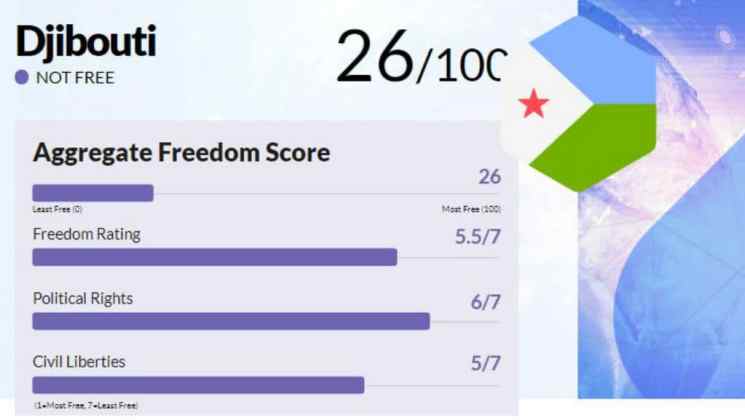
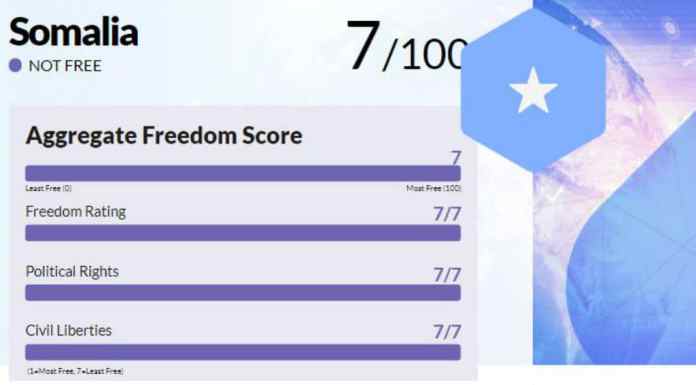
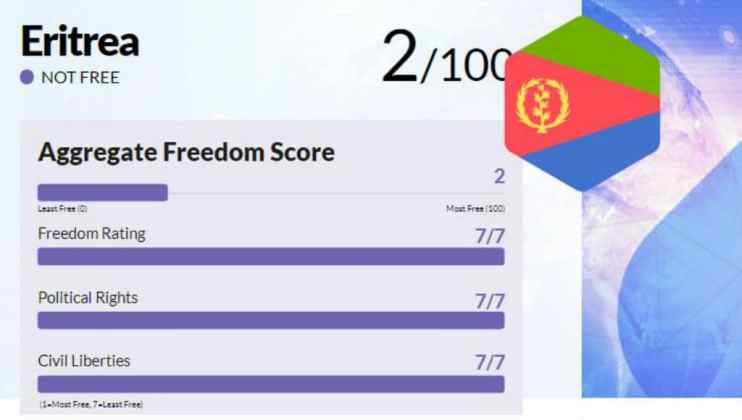
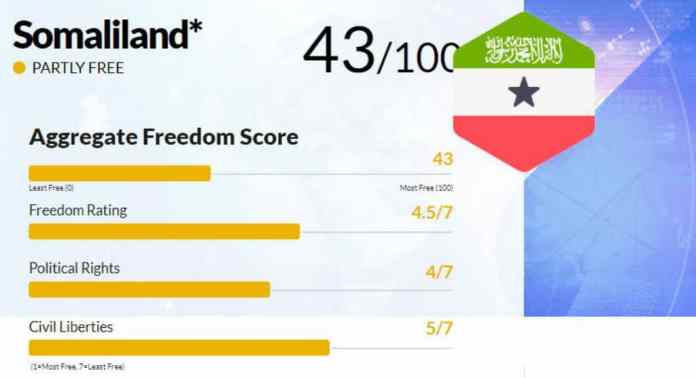
(afrika-times.com) In its recently-released annual report, Freedom in the World 2021, the watchdog said Somaliland scored 43 on the 100-point Freedom House Index, while Ethiopia scored 19, Djibouti scored 26, Eritrea scored 2 and Somalia also scored 7 on the 100-point Freedom House index.
US-based independent watchdog Freedom House has asserted it’s latest report that the Somaliland enjoys more freedom than other Horn of Africa’s countries like Ethiopia, Djibouti, Eritrea, and Somalia.

The US was rated 86 on the index, closely followed by India at 75.Germany and France scored higher than the US as Freedom House expressed concern over the state of affairs in America.Interestingly, the Indian state of Jammu & Kashmir enjoys more freedom than Pakistan and Pakistan-Occupied Kashmir (PoK) contrary to allegations leveled by Imran Khan-led government in Pakistan.
Jammu & Kashmir scored 49 on the 100-point Freedom House Index, while Pakistan scored 39 and PoK a paltry 28. The report also labeled PoK as “not free” in terms of freedom enjoyed by its residents and the functioning of local institutes.While the report termed Pakistan as “partly free”, it labeled India a “free” country alongside the US, several European nations, Japan, Australia, South Africa, and several Latin American countries.“Elections in Somaliland have been relatively free and fair, but years-long delays have meant that elected officials serve well beyond their original mandates.
Journalists face pressure from authorities, and police have employed excessive force and engaged in arbitrary detention. Minor clans are subject to political and economic marginalization, and violence against women remains a serious problem,” the report said, adding that “Somaliland’s political rights rating improved from 5 to 4 due to the holding of a long-delayed presidential election.”On the electoral process, the Freedom House had said in its report in 2018 “The president is directly elected for a maximum of two five-year terms and appoints the cabinet.
The electoral mandate of incumbent president Ahmed Mohamed Mohamoud “Sillanyo” of the Peace, Unity, and Development Party (Kulmiye) expired in 2015, but the presidential election due that year was not held until November 2017.
Muse Bihi Abdi, the Kulmiye candidate, won the contest with 55 percent of the vote, followed by Abdurahman Mohamed Abdullahi of the opposition Wadani party with 40 percent and Faisal Ali Warabe of the For Justice and Development (UCID) party with 4 percent.International monitors identified some irregularities in the process—including unstamped ballot papers and underage voting—and there was an outbreak of violence while results were being finalized, with police firing on pro-Wadani protesters amid suspicions of fraud. However, the observers concluded that such problems did not significantly affect the final result, which Wadani ultimately accepted in the public interest.Score Change: The score improved from 0 to 3 because Somaliland held a competitive presidential election, ending a two-year period in which the chief executive lacked an electoral mandate.”Be the first to know – Follow us on Twitter @SaxafiThe Freedom House report with a focus on “democracy in retreat” said in 2018, freedom in the world recorded the 13th consecutive year of decline in global freedom. Domestic attacks on key institutions—the judiciary, the media, and electoral mechanisms—are undermining the foundations of democracy, the report said.It said at the same time, a global assault on the norms of democracy, led by an increasingly assertive China, challenges their spread around the world. Only by strengthening democracy at home and standing together in its defense around the world can democracies protect their values and preserve their ability to expand freedom globally, the report said.
It also said that the internet and other digital technologies have become ubiquitous as a means of accessing information, communicating, and participating in public debates. Consequently, technology and social media companies play an increasingly important role in sustaining—or weakening—democracy.
Author: Africa Times News

 All Africa